

Featured

Accelerating Materials Innovation with Generative Foundation Models
Aerobase joins GENMAT to connect AI-driven, multi-scale materials discovery with finite-element simulation and structural deployment.
Read article
Field notes on materials, simulation and the AI agents changing how engineering decisions are made.
Latest story
Aerobase joins GENMAT to connect AI-driven, multi-scale materials discovery with finite-element simulation and structural deployment.

The CiSMA project develops material models that account for trace elements in recycled steel for safer automotive forming, welding and crash performance.
GEAR-UP applies advanced modelling to recycled metals and composites, helping additive-manufactured parts meet the performance of virgin materials.

Flexcrash combines lightweight materials, virtual testing and automated crash reconstruction to improve vehicle safety without sacrificing structural efficiency.

UPBEAT integrates uncertainty quantification into aircraft-component lifecycles to improve reliability, manufacturing efficiency and environmental performance.

Adaptive beam shapes, process monitoring and closed-loop control improve quality and productivity in laser-based additive manufacturing.

RESTORE advances circular manufacturing through modular design, repair technologies and optimized laser cladding and DED processes.

Hybrid manufacturing and tailored surface patterns create lighter crash-tolerant structures with improved safety and sustainability.

Why accurate material behaviour remains the critical link between advanced finite-element solvers and trustworthy automotive crash simulation.
A practical introduction to inverse calibration, constitutive-model selection and optimization for reliable finite-element simulation.
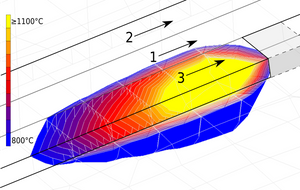
Combined metallurgical and flow-stress models help predict stress and distortion during additive manufacturing of Ti-6Al-4V.
A software architecture combining microstructure models, finite-element solvers and multi-objective optimization for shape rolling.
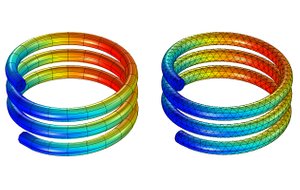
How state variables are transferred between dissimilar meshes while limiting gradient diffusion and maintaining numerical stability.

FLUIDMESH uses image processing and minimal user input to generate practical two-dimensional unstructured quadrilateral meshes.

Material modelling for high-strength low-alloy steels used in demanding automotive, infrastructure and heavy-engineering applications.
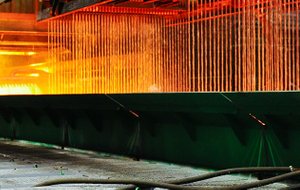
Modelling the substantial changes in microstructure and material properties that develop throughout industrial hot rolling.
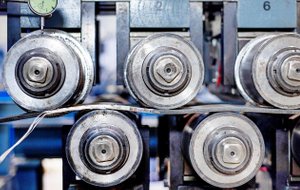
Finite-element simulation of coil leveling and the repeated bending required before sheet material enters downstream processing.
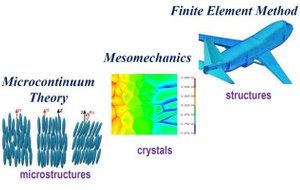
An introduction to the crystalline mechanisms and defects that shape plastic deformation and the mechanical response of metals and alloys.
Swipe, select, or use the arrows